
Anyone who’s visited York knows it’s a city that captures the imagination. Every time you gaze up at the soaring spires of the Minster or walk beneath the warped beams of the wonky shops along The Shambles, you don’t just see the buildings. You sense the stories that have taken place here over the years. As if the city itself is alive.
It’s no wonder then that novelists and filmmakers over the years have chosen York to stage their sagas and tales – everything from royal intrigues and magical epics to police procedurals and, naturally, an abundance of period dramas.
Perhaps you’ve fallen in love with York and seek something to read or watch that recreates the city’s magic for you. Or maybe you’re planning a first visit and need some inspiration. Either way, we’re sure you’ll enjoy our guide to York on the page and screen.
Novels where history meets mystery
Sovereign is the third of seven novels in the Shardlake series by CJ Sansom. Set during the reign of Henry VIII, they follow the barrister Matthew Shardlake as he investigates murders and finds himself drawn into political and religious intrigues. Sovereign is set in York, following Henry’s ‘Great Progress to York’, a huge display of power designed to quell Northern rebellion.
The King’s Manor, which features heavily in the book, is now part of York Unviersity. Only the courtyard and library are accessible to the public, but you certainly get a sense of the medieval grandeur. And you can of course see and explore Clifford’s Tower, once part of York Castle. It forms a memorable plotpoint in the book, when Shardlake and his companion Barak see the skeleton of Robert Aske, the leader of the Pilgrimage of Grace uprising, hanging from the walls in chains.
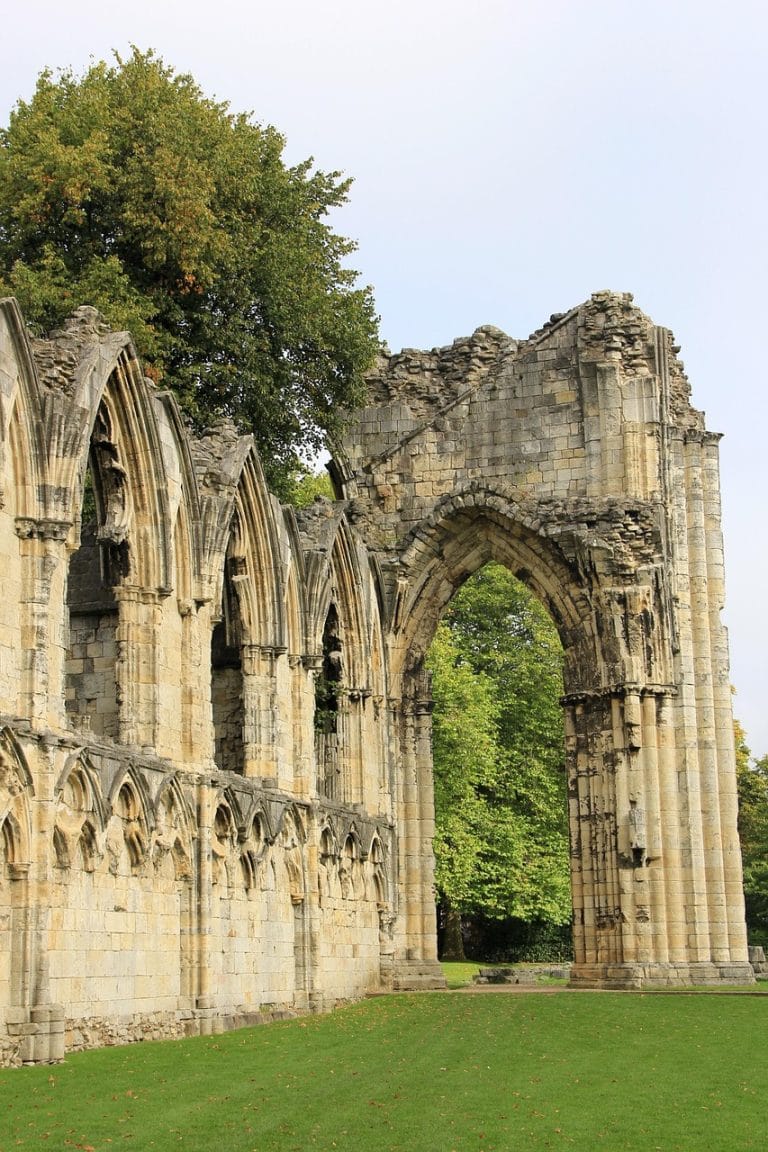
And of course, the Museum Gardens are home to the forlorn ruins of St Marys Abbey, rising out of the lawns – it was a key location in the story, having only been closed down two years before the novel was set.
Another option if you love a good dollop of mystery with your history is Candace Robb’s Owen Archer series. Set in the 14th century, they follow a veteran Welsh archer who’s enlisted as a spy by the Archbishop of York. The series introduces you to a host of real figures from York’s medieval past, as well as many more fictional ones who bring the city and the era to life.
Taking in the broad sweep of York’s history in a single set of novels is a mammoth task. But one author brave enough to attempt it is Cynthia Harrod-Eagles. Her Morland Dynastry series follows the trials of one York family through 600 years, from the War of the Roses up to the onset of World War II. What started out as a plan for a 12-novel series currently stands at 36 novels, published over a 44-year span, each one packed full of family dramas and meticulous historical detail.
Many people arrive in York searching for magic. That is also how Jonathan Strange and Mr Norrell, Susanna Clarke’s alternate-history epic begins. A magical theorist arrives in York seeking one of the last remaining practical magicians, before the story sweeps through London, Venice, and the Napoleonic Wars. The acclaimed TV adaptation featured scenes at York Minster and St William’s College, a beautifully preserved 15th-century building in the Minster’s shadow.
A backdrop fit for a queen… or two
Of course, York’s magic extends beyond the page, and filmmakers have noticed.
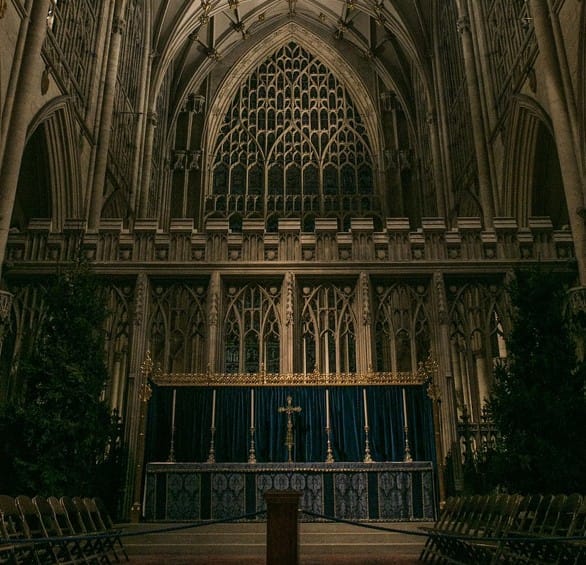
As one of Britain’s most magnificent cathedrals, York Minster is unsurprisingly a prime choice – particularly for shows about the monarchy. It doubled as Westminster Abbey for the movie Elizabeth, during the coronation of the Tudor Queen, played unforgettably by Cate Blanchett in her Oscar-winning turn.
Another starring role in royal telly for the Minster came in the hit Netflix series The Crown. It stood in for St. George’s Chapel at Windsor Castle, as the setting for Charles and Camilla’s wedding and the emotional series finale with Imelda Staunton as Queen Elizabeth II.
Period dramas
Another beloved Yorkshire period drama, Gentleman Jack, may have been set primarily in West Yorkshire, but many of York’s streets and buildings were used to create that Victorian grandeur. Fairfax House was used for interior shots of the home of one of Anne Lister’s love interests, while Gray’s Court lent its medieval courtyard to some external scenes.
But the most significant place it featured is Holy Trinity Church, Goodramgate. Not only was the scene of Anne Lister and Ann Walker taking the sacrament to bless their union filmed there, but it’s also where the event really took place in 1834. It’s believed to be the first blessing of a same-sex union in Britain, and the church has become an important landmark for the UK LGBTQ community.
Perhaps no TV series have made greater use of York as a backdrop than Death Comes To Pemberley. Despite being set in a fictional Derbyshire estate, York Minster, St William’s College, Treasurer’s House, York Castle Museum and York Crown Court all featured in the three-parter, based on P.D. James’s continuation of Jane Austen’s Pride and Prejudice.
While the ancient grandeur of York certainly lends itself to period dramas, the city has also played host to more contemporary productions. Patience, a police drama about an archivist with autism who helps a detective solve crimes, is set here. Iconic locations such as The Minster, The Shambles and Micklegate all featured in exterior shots.
All aboard to the movies
If you’re arriving in York via train, you might well retrace the steps of some of your favourite movie stars. York Railway Station famously stood in for King’s Cross in Harry Potter and the Philosopher’s Stone as Hagrid sent Harry off, rather bemusedly, to look for Platform 9 ¾.
And the station featured in the closing scenes of the Oscar-winning Chariots of Fire, as the heroes return from the Olympics.
Dustin Hoffman could be spotted around York station in the 1970s as he played an American reporter who fell in love with Vanessa Redgrave’s Agatha Christie. The movie, Agatha, centres around the novelist’s disappearance in Harrogate, not too far away.